PepsiCo Juiced Up for Russia
From UBS Investment Research
PEPSICO AND PEPSI BOTTLING GROUP are set to acquire the juice business of Lebedyansky, Russia's leading juice manufacturer for $1.4 billion and approximately $500 million of debt, which implies 17 times 2007 estimated enterprise value to earnings before interest, taxes, depreciation and amortization.
We expect the deal to close after the end of the third quarter of 2008.
Following Coca-Cola's joint venture with Coca-Cola Hellenic Bottling for Multon [a Russian fruit juice company] in 2005, it was expected that PepsiCo was also searching for a strong juice company that would provide it with access to the fast-growing Russian market.
Speculation that Lebedyansky would be PepsiCo's target has been ongoing for almost two years, and on March 20, PepsiCo agreed to buy a majority stake in Lebedyansky along with its largest bottler, Pepsi Bottling Group. PepsiCo and Pepsi Bottling Group will form a joint venture for the Lebedyansky business, with PepsiCo taking a 75% stake and Pepsi Bottling Group taking a 25% stake compared to their current partnership in Russia in which PepsiCo has a 60% stake and Pepsi Bottling Group has a 40% stake.
We believe the deal will be financed with debt, be neutral on 2008 earnings and slightly accretive in 2009 for PepsiCo and Pepsi Bottling Group. We rate PepsiCo at Buy and believe they can continue to deliver double-digit earnings growth, led by international where we believe the company is hitting reinvestment tipping points. We rate Pepsi Bottling Group at Buy as we are positive on higher penny-profit contribution from new products, cost savings from 2007 restructuring and easier cold drink comparable sales.
Lebedyansky is the leading Russia juice player with about 32% value market share. Company has strong brands: Ya (premium), Tonus (medium) and Fruit Garden (economy). Lebedyansky's distribution is considered to be one of the best in the country.
We are optimistic on the potential of the Russian juice market, as sales totaled more than $3 billion in 2007 growing double-digits, and per-cap consumption continues to increase. We expect double-digit sales growth to continue through 2010 as income levels continue to rise, allowing more consumers to purchase juice.
We expect the Russian juice market to show a volume compound annual growth rate from 2006 to 2010 of 9.6%. Why do we expect Russians to drink more juices? Growing incomes change consumption habits, and we expect them to become more diversified.
We forecast that per-capita juice consumption will double from 17 liters in 2006 to over 34 liters by 2014, reaching current European levels. Per-capita consumption in Moscow already exceeds 34 liters. Juices are winning an increased share, replacing carbonated drinks and tea.
We expect Lebedyansky will be a key beneficiary as juice sales continue to grow at 15%-plus through 2010. We also believe Lebedyansky margins can improve as PepsiCo's global procurement and manufacturing capabilities should drive cost of goods sold lower.
Additionally, Lebedyansky has been supporting growth in Siberia with production from two plants which are located in Moscow and St. Petersburg. Their new plant in Siberia should lower transportation costs significantly and thus lead to margin improvement.
Friday, April 4, 2008


Business Week's No. 3 Company - Allegheny Technologies
No. 3: Allegheny Technologies
Industry: Materials
Sales: $5.5 billion
Net Income: $747.1 million
Allegheny Technologies' (ATI) titanium is a vital material for airplanes and jet engines and is a key ingredient in the hot-selling, though oft-delayed, Boeing 787 Dreamliner. In 2007, such so-called high-performance metals kicked in 76% of the Pittsburgh company's $1.2 billion in operating profits, despite making up just 40% of sales. CEO Patrick Hassey has committed more than $800 million to expanding production. Shares have slumped in the past year, though, as higher materials costs have led industrial customers to cut back on orders for stainless steel, a big revenue source.
Industry: Materials
Sales: $5.5 billion
Net Income: $747.1 million
Allegheny Technologies' (ATI) titanium is a vital material for airplanes and jet engines and is a key ingredient in the hot-selling, though oft-delayed, Boeing 787 Dreamliner. In 2007, such so-called high-performance metals kicked in 76% of the Pittsburgh company's $1.2 billion in operating profits, despite making up just 40% of sales. CEO Patrick Hassey has committed more than $800 million to expanding production. Shares have slumped in the past year, though, as higher materials costs have led industrial customers to cut back on orders for stainless steel, a big revenue source.
Business Week's No. 2 Company - Gilead Sciences
No. 2: Gilead Sciences
Industry: Biotechnology
Sales: $4.2 billion
Net Income: $1.6 billionGilead Sciences' (GILD) resounding lead in HIV treatments has landed it on the BusinessWeek 50 list for the fourth year in a row. In 2007, sales at the Foster City (Calif.) company rose 40%, to $4.2 billion, driven largely by Atripla, a drug that combines three potent medicines into one pill. All told, Gilead shareholders enjoyed a 32% return in the 12 months ended Mar. 13. Meanwhile, Chief Executive John Martin has been branching out: A drug to treat pulmonary arterial hypertension was approved in June, and drugs for cystic fibrosis and hepatitis B are awaiting approval by the Food & Drug Administration.
Industry: Biotechnology
Sales: $4.2 billion
Net Income: $1.6 billionGilead Sciences' (GILD) resounding lead in HIV treatments has landed it on the BusinessWeek 50 list for the fourth year in a row. In 2007, sales at the Foster City (Calif.) company rose 40%, to $4.2 billion, driven largely by Atripla, a drug that combines three potent medicines into one pill. All told, Gilead shareholders enjoyed a 32% return in the 12 months ended Mar. 13. Meanwhile, Chief Executive John Martin has been branching out: A drug to treat pulmonary arterial hypertension was approved in June, and drugs for cystic fibrosis and hepatitis B are awaiting approval by the Food & Drug Administration.
Wednesday, April 2, 2008
Business Week's No. 1 Company - Coach
From Business Week -
No. 1: Coach
Industry: Apparel, Accessories & Luxury GoodsSales: $2.9 billionNet Income: $713.9 million. How Coach (COH) took the top ranking in the BusinessWeek 50 can be summed up in two percentages: The New York handbag maker and retailer posted average sales growth of 24% over the last three years while generating a 61% average return on invested capital. The results are a testament to Chief Executive Lew Frankfort's strategy of moving the brand more upscale, as well as the skillful way designer Reed Krakoff has increased the brand’s sex appeal. Coach has added higher-cost bags to make the brand more aspirational: Bags that cost $400 or more now represent 22% of sales. And Coach, unlike most retailers, had strong results this past holiday season. But as the consumer loses steam, Coach has lost momentum. Over the past six months, the stock has dropped 30%. The company has responded by adding new lines of lower-priced handbags. Frankfort and Co. apparently aren't too worried: They are boosting store expansion this year.
Hey, I wonder if they make a "man" purse?
Full Disclosure - Coach is in my own personal portfolio
No. 1: Coach
Industry: Apparel, Accessories & Luxury GoodsSales: $2.9 billionNet Income: $713.9 million. How Coach (COH) took the top ranking in the BusinessWeek 50 can be summed up in two percentages: The New York handbag maker and retailer posted average sales growth of 24% over the last three years while generating a 61% average return on invested capital. The results are a testament to Chief Executive Lew Frankfort's strategy of moving the brand more upscale, as well as the skillful way designer Reed Krakoff has increased the brand’s sex appeal. Coach has added higher-cost bags to make the brand more aspirational: Bags that cost $400 or more now represent 22% of sales. And Coach, unlike most retailers, had strong results this past holiday season. But as the consumer loses steam, Coach has lost momentum. Over the past six months, the stock has dropped 30%. The company has responded by adding new lines of lower-priced handbags. Frankfort and Co. apparently aren't too worried: They are boosting store expansion this year.
Hey, I wonder if they make a "man" purse?
Full Disclosure - Coach is in my own personal portfolio
Visa - Worldwide
By Paul Tracy
Visa (NYSE: V), like its main rival MasterCard (NYSE: MA), is not a bank and it does not make loans, assume credit risk or set interest rates on credit cards -- the actual loan is made by the bank or consumer credit firm that issues the card. Rather, Visa simply handles the processing of card payments made with Visa branded cards. Visa derives revenues in two main ways ways: fees charged to merchants every time a payment is processed, and the licensing fees it charges banks for the use of its "Visa" brand.
Visa's main competitive advantage is its size and the widespread acceptance of its cards. Specifically, Visa cards are accepted by more merchants than any other brand, including American Express (NYSE: AXP) and MasterCard.
Visa enjoys a dominant share of global credit card processing volume. Of the roughly $6 trillion in total transactions processed by the six largest payment processing firms in 2006, Visa held a 55% share. That compares to just 32% for its main rival, MasterCard. And in terms of the total number of transactions, Visa held a 60% share in 2006 against MasterCard's 31%. As a result of this dominance, banks want to license the Visa brand and consumers want to hold Visa cards to ensure widespread acceptance.
Going forward, Visa should continue to benefit from two main catalysts: the overall increase in the use of electronic payments and strong growth in emerging markets. As for the first point, consumers all over the world are increasingly switching from cash and check payments to more convenient credit card and debit card transactions. Electronic payments are simply faster, more secure, and create less paperwork.
And while electronic payments are still growing nicely in the developed world, growth in emerging markets is even more impressive. Consider that due to rapid economic growth in recent years a growing number of consumers in markets like China and India have enough income to take out their first credit cards. In many such countries, consumers are using electronic payments and are foregoing checks entirely. As consumer spending in these rapidly growing economies picks up steam, so will the volume of credit card transactions.
For example, the dollar volume of Visa transactions in the U.S. grew at a +12% annualized pace from 2000 to 2006. However, in Asia and Latin America, transaction volumes grew at +18% and +21%, respectively, over the same time period. According to Visa's registration statement with the SEC, the company expects transaction growth in emerging markets to accelerate and to continue to exceed growth in the developed world through 2012. Visa has been adding new merchants and banks to its network in key emerging markets such as China and India; it is particularly well placed to grow in these markets in the coming years.
Visa's main competitor, MasterCard, has been one of the most successful IPOs of the past few years. And while the stock saw a nice first-day pop, that gain wasn't fleeting -- the stock has soared +380% since the closing bell on its first day of trading.
And Visa is the dominant player in the global payment processing business, so it will benefit even more from the same positive trends as MA.
Visa (NYSE: V), like its main rival MasterCard (NYSE: MA), is not a bank and it does not make loans, assume credit risk or set interest rates on credit cards -- the actual loan is made by the bank or consumer credit firm that issues the card. Rather, Visa simply handles the processing of card payments made with Visa branded cards. Visa derives revenues in two main ways ways: fees charged to merchants every time a payment is processed, and the licensing fees it charges banks for the use of its "Visa" brand.
Visa's main competitive advantage is its size and the widespread acceptance of its cards. Specifically, Visa cards are accepted by more merchants than any other brand, including American Express (NYSE: AXP) and MasterCard.
Visa enjoys a dominant share of global credit card processing volume. Of the roughly $6 trillion in total transactions processed by the six largest payment processing firms in 2006, Visa held a 55% share. That compares to just 32% for its main rival, MasterCard. And in terms of the total number of transactions, Visa held a 60% share in 2006 against MasterCard's 31%. As a result of this dominance, banks want to license the Visa brand and consumers want to hold Visa cards to ensure widespread acceptance.
Going forward, Visa should continue to benefit from two main catalysts: the overall increase in the use of electronic payments and strong growth in emerging markets. As for the first point, consumers all over the world are increasingly switching from cash and check payments to more convenient credit card and debit card transactions. Electronic payments are simply faster, more secure, and create less paperwork.
And while electronic payments are still growing nicely in the developed world, growth in emerging markets is even more impressive. Consider that due to rapid economic growth in recent years a growing number of consumers in markets like China and India have enough income to take out their first credit cards. In many such countries, consumers are using electronic payments and are foregoing checks entirely. As consumer spending in these rapidly growing economies picks up steam, so will the volume of credit card transactions.
For example, the dollar volume of Visa transactions in the U.S. grew at a +12% annualized pace from 2000 to 2006. However, in Asia and Latin America, transaction volumes grew at +18% and +21%, respectively, over the same time period. According to Visa's registration statement with the SEC, the company expects transaction growth in emerging markets to accelerate and to continue to exceed growth in the developed world through 2012. Visa has been adding new merchants and banks to its network in key emerging markets such as China and India; it is particularly well placed to grow in these markets in the coming years.
Visa's main competitor, MasterCard, has been one of the most successful IPOs of the past few years. And while the stock saw a nice first-day pop, that gain wasn't fleeting -- the stock has soared +380% since the closing bell on its first day of trading.
And Visa is the dominant player in the global payment processing business, so it will benefit even more from the same positive trends as MA.
Verizon - AT&T, Can You Hear Me Now
AT&T and Verizon: Winning the Air War
By TIERNAN RAY
THE UNITED STATES' TWO LARGEST PHONE companies just took out a lease on the future, and buying their stocks could also be a good long-term investment.
AT&T, which owns the largest cellular outfit in the land, and Verizon Communications, whose wireless service is No. 2, bid roughly $16 billion last month effectively to rent airwaves that will put both companies well ahead of U.S. wireless competitors Sprint Nextel and T-Mobile (a unit of Deutsche Telekom).
The benefits of the auction will take years to unfold, but the bids are significant for what they say about AT&T's and Verizon's financial positions: Both are borrowing and spending billions on top of the billions they already owe. That makes them, in effect, two gold-plated borrowers that can still tap the credit markets even in the worst credit crisis the U.S. has seen in decades.
AT&T will likely end 2008 being the top corporate debtor in the land, outside of financial firms, and Verizon just went into the debt market again today, with an apparently strong reception from credit markets, according to Citigroup's debt analysts.
And that suggests both stocks are stable, high-dividend-paying investments that should appreciate as both companies become even more secure competitively in coming years.
Shares of both AT&T and Verizon have fared better than the Standard & Poor's 500 in the last 12 months. Factoring in dividends (see At a Glance), AT&T returned 2.8%, and Verizon, 3.52%, versus a 2.6% decline for the S&P 500, counting dividends.
"Both AT&T and Verizon have locked in a competitive advantage with these auctions," says Blair Levin, a former Federal Communications Commission official and now a telecom strategist with Stifel Nicolaus in Washington, D.C.
"There's nothing that comes close to these two companies in the telecom sector," adds Citigroup corporate bond analyst David Hamburger, referring to the fact that both companies' bonds are a solid single-A, versus competitor Sprint, whose debt rating varies from junk to near-junk.
If the benefits of the auction are not immediately clear to investors, it's because both companies will have to spend more to erect more cell towers, with uncertain return.
That uncertainty has kept the stocks from fully reacting to this favorable development. In fact, the stocks hardly moved when the auction results were announced on March 20.
"Both companies have set themselves up pretty well far into the future by creating an inventory of exceptionally high-quality spectrum," says telecom analyst Craig Moffett with Sanford Bernstein. "Now comes the follow-on question -- can they earn a return on the investment?"
Thanks to the physical properties of the airwaves both companies just won, the answer should ultimately be yes because capital costs could be minimized. The auction was for airwaves at a frequency of 700 megahertz.
Those wavelengths go through buildings easier than today's cellular frequencies at 1900 megahertz. That means AT&T and Verizon could offer in-building cellular phone coverage without having to put radio equipment in buildings.
Moreover, because 700 megahertz wavelengths travel farther than higher frequencies, both AT&T and Verizon could cover their markets using fewer towers than competitors Sprint and T-Mobile, who have higher frequencies.
"The deployment costs [for AT&T and Verizon] are less than for WiMax," says analyst Tom Watts with Cowen & Co., referring to Sprint's next-generation wireless technology, which will be offered commercially starting this year. "The numbers I've seen suggest they could get by with as little as one-quarter of the infrastructure in towers and equipment as for WiMax," says Watts.
(Construction likely won't start until after TV broadcasters currently occupying 700 megahertz spectrum vacate early next year.)
If AT&T and Verizon can minimize capital required to build the 700 megahertz spectrum, while raising prices for broadband wireless connections, the profits they reap will help to offset their declining wireline phone business and protect the dividend.
The question remains whether investors are buying AT&T's and Verizon's shares as growth stocks or value stocks, an issue that Bernstein's Moffett says weighs on the shares.
"We're going through a transition in the Verizon shareholder base," says Moffett. "The bloom is off the rose in the wireless business," as the U.S. wireless market becomes more mature, says Moffett. About 84% of the market has cellular service in the U.S., trimming growth prospects for wireless services.
The danger is that as the growth engine of wireless cools, and AT&T and Verizon attract more conservative, value-type investors, those investors may become impatient with the future capital requirements of building out the 700 megahertz spectrum.
But a look at AT&T's and Verizon's debt suggests both companies have the financial flexibility to deliver the two things that really matter: dividends and buybacks.
AT&T in 2008 will issue about $17 billion of new debt, of which $6.6 billion will go to paying for the spectrum they're leasing, according to Citigroup's Hamburger.
Another $8 billion could go to share repurchase, he expects. And the dividend is safe, says Hamburger: "We're expecting that's a fixed cost that will be there for the foreseeable future."
As for Verizon, it may issue about $15 billion of new debt this year, estimates Hamburger, of which $2.5 billion could go for share buybacks.
Not only are both companies able to tap credit markets, but both have seen their cost of borrowing rise only slightly, says Hamburger. Where AT&T's cost of debt was 5.5%, on average, in 2007, it will only rise "by 20 or 30 basis points," above Treasuries, he projects, indicating AT&T, and Verizon, are getting favorable terms to borrow.
Compare that to other businesses that may be seeing spreads of 400 basis points or more, says Hamburger.
It's too early to tell what profits AT&T and Verizon will wring from their auction leases; the networks haven't even been built yet. But with the credit markets essentially willing to lend both companies billions of dollars for new investment, it seems the things value investors care about -- namely dividends and share repurchases -- will remain secure as both companies extend their lock on the wireless market.
By TIERNAN RAY
THE UNITED STATES' TWO LARGEST PHONE companies just took out a lease on the future, and buying their stocks could also be a good long-term investment.
AT&T, which owns the largest cellular outfit in the land, and Verizon Communications, whose wireless service is No. 2, bid roughly $16 billion last month effectively to rent airwaves that will put both companies well ahead of U.S. wireless competitors Sprint Nextel and T-Mobile (a unit of Deutsche Telekom).
The benefits of the auction will take years to unfold, but the bids are significant for what they say about AT&T's and Verizon's financial positions: Both are borrowing and spending billions on top of the billions they already owe. That makes them, in effect, two gold-plated borrowers that can still tap the credit markets even in the worst credit crisis the U.S. has seen in decades.
AT&T will likely end 2008 being the top corporate debtor in the land, outside of financial firms, and Verizon just went into the debt market again today, with an apparently strong reception from credit markets, according to Citigroup's debt analysts.
And that suggests both stocks are stable, high-dividend-paying investments that should appreciate as both companies become even more secure competitively in coming years.
Shares of both AT&T and Verizon have fared better than the Standard & Poor's 500 in the last 12 months. Factoring in dividends (see At a Glance), AT&T returned 2.8%, and Verizon, 3.52%, versus a 2.6% decline for the S&P 500, counting dividends.
"Both AT&T and Verizon have locked in a competitive advantage with these auctions," says Blair Levin, a former Federal Communications Commission official and now a telecom strategist with Stifel Nicolaus in Washington, D.C.
"There's nothing that comes close to these two companies in the telecom sector," adds Citigroup corporate bond analyst David Hamburger, referring to the fact that both companies' bonds are a solid single-A, versus competitor Sprint, whose debt rating varies from junk to near-junk.
If the benefits of the auction are not immediately clear to investors, it's because both companies will have to spend more to erect more cell towers, with uncertain return.
That uncertainty has kept the stocks from fully reacting to this favorable development. In fact, the stocks hardly moved when the auction results were announced on March 20.
"Both companies have set themselves up pretty well far into the future by creating an inventory of exceptionally high-quality spectrum," says telecom analyst Craig Moffett with Sanford Bernstein. "Now comes the follow-on question -- can they earn a return on the investment?"
Thanks to the physical properties of the airwaves both companies just won, the answer should ultimately be yes because capital costs could be minimized. The auction was for airwaves at a frequency of 700 megahertz.
Those wavelengths go through buildings easier than today's cellular frequencies at 1900 megahertz. That means AT&T and Verizon could offer in-building cellular phone coverage without having to put radio equipment in buildings.
Moreover, because 700 megahertz wavelengths travel farther than higher frequencies, both AT&T and Verizon could cover their markets using fewer towers than competitors Sprint and T-Mobile, who have higher frequencies.
"The deployment costs [for AT&T and Verizon] are less than for WiMax," says analyst Tom Watts with Cowen & Co., referring to Sprint's next-generation wireless technology, which will be offered commercially starting this year. "The numbers I've seen suggest they could get by with as little as one-quarter of the infrastructure in towers and equipment as for WiMax," says Watts.
(Construction likely won't start until after TV broadcasters currently occupying 700 megahertz spectrum vacate early next year.)
If AT&T and Verizon can minimize capital required to build the 700 megahertz spectrum, while raising prices for broadband wireless connections, the profits they reap will help to offset their declining wireline phone business and protect the dividend.
The question remains whether investors are buying AT&T's and Verizon's shares as growth stocks or value stocks, an issue that Bernstein's Moffett says weighs on the shares.
"We're going through a transition in the Verizon shareholder base," says Moffett. "The bloom is off the rose in the wireless business," as the U.S. wireless market becomes more mature, says Moffett. About 84% of the market has cellular service in the U.S., trimming growth prospects for wireless services.
The danger is that as the growth engine of wireless cools, and AT&T and Verizon attract more conservative, value-type investors, those investors may become impatient with the future capital requirements of building out the 700 megahertz spectrum.
But a look at AT&T's and Verizon's debt suggests both companies have the financial flexibility to deliver the two things that really matter: dividends and buybacks.
AT&T in 2008 will issue about $17 billion of new debt, of which $6.6 billion will go to paying for the spectrum they're leasing, according to Citigroup's Hamburger.
Another $8 billion could go to share repurchase, he expects. And the dividend is safe, says Hamburger: "We're expecting that's a fixed cost that will be there for the foreseeable future."
As for Verizon, it may issue about $15 billion of new debt this year, estimates Hamburger, of which $2.5 billion could go for share buybacks.
Not only are both companies able to tap credit markets, but both have seen their cost of borrowing rise only slightly, says Hamburger. Where AT&T's cost of debt was 5.5%, on average, in 2007, it will only rise "by 20 or 30 basis points," above Treasuries, he projects, indicating AT&T, and Verizon, are getting favorable terms to borrow.
Compare that to other businesses that may be seeing spreads of 400 basis points or more, says Hamburger.
It's too early to tell what profits AT&T and Verizon will wring from their auction leases; the networks haven't even been built yet. But with the credit markets essentially willing to lend both companies billions of dollars for new investment, it seems the things value investors care about -- namely dividends and share repurchases -- will remain secure as both companies extend their lock on the wireless market.
Tuesday, April 1, 2008
Business Week's Top 50
The companies that make up the BusinessWeek 50 represent our picks as the top performers in each of the 10 sectors that make up the S&P 500. To select this year's overachievers, we ran the S&P 500 through a proprietary screen that ranks those companies within sectors by two key metrics: return on investment and sales growth over the past three years, and for financial-service firms, their returns on equity and growth in assets. To provide the analysis and perspective that computers can't, BusinessWeek's editors and reporters then reviewed each company on the list, making a limited number of changes and deletions where warranted.
Each day (for the next 50 days) I will highlight each company. Highlighted tomorrow will be Coach.
Each day (for the next 50 days) I will highlight each company. Highlighted tomorrow will be Coach.
Bailing Out Bear Stearns
By Peter Coy (Business Week)
So far, few people have focused on what exactly the Fed is getting in exchange for supplying $29 billion to JPMorgan Chase. That's a bit surprising because whatever the deal is, it's far from a standard loan. The strangest twist is that even though the money goes to JPMorgan, that firm isn't the borrower. So the Fed can't demand repayment from JPMorgan if the Bear assets turn out to be worth less than promised.
What's also odd is that if there's money left after loans are paid off, the Fed gets to keep the residual value for itself. That's what one would expect if the Fed were buying the assets, not just treating them as collateral for a loan. Vincent R. Reinhart, a former director of the Fed's Division of Monetary Affairs and now a resident scholar at the American Enterprise Institute, said in an interview on Mar. 26: "The New York Fed is the residual claimant. That doesn't look to me like a loan. That looks like equity."
Here's how it works: A Delaware-based limited liability company will be set up to receive, upon completion of the merger, $30 billion in various Bear holdings, such as mortgage-backed securities. The Fed will lend $29 billion to that company, which will pass all the money along to JPMorgan, Bear's new owner. JPMorgan itself will lend $1 billion to the Delaware company. The company, managed by BlackRock Financial Management, will pay back the loans by gradually liquidating the assets. As a protection for the Fed, it gets paid back fully before JPMorgan gets back anything on its loan. The other sweetener for the Fed is that if there's money left over even after JPMorgan gets repaid, the Fed gets it all
So far, few people have focused on what exactly the Fed is getting in exchange for supplying $29 billion to JPMorgan Chase. That's a bit surprising because whatever the deal is, it's far from a standard loan. The strangest twist is that even though the money goes to JPMorgan, that firm isn't the borrower. So the Fed can't demand repayment from JPMorgan if the Bear assets turn out to be worth less than promised.
What's also odd is that if there's money left after loans are paid off, the Fed gets to keep the residual value for itself. That's what one would expect if the Fed were buying the assets, not just treating them as collateral for a loan. Vincent R. Reinhart, a former director of the Fed's Division of Monetary Affairs and now a resident scholar at the American Enterprise Institute, said in an interview on Mar. 26: "The New York Fed is the residual claimant. That doesn't look to me like a loan. That looks like equity."
Here's how it works: A Delaware-based limited liability company will be set up to receive, upon completion of the merger, $30 billion in various Bear holdings, such as mortgage-backed securities. The Fed will lend $29 billion to that company, which will pass all the money along to JPMorgan, Bear's new owner. JPMorgan itself will lend $1 billion to the Delaware company. The company, managed by BlackRock Financial Management, will pay back the loans by gradually liquidating the assets. As a protection for the Fed, it gets paid back fully before JPMorgan gets back anything on its loan. The other sweetener for the Fed is that if there's money left over even after JPMorgan gets repaid, the Fed gets it all
Sector Outlook
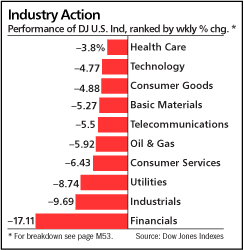
Of the ten major market sectors; Basic Materials (-3.40%), Consumer Goods (-5.42%), Consumer Services (-7.95%), Financials (-14.29%), Health Care (-11.02%), Industrials (-6.73%), Oil&Gas (-6.96%), Technology (-16.40%), Telecommunications (-16.78%),
and Utilities (-11.42%), none are up year to date.
The following nine sub sectors are up year to date; Steel (+5.63%), Home Improvement Retailers (+1.10%), Home Construction (+12.46%), Biotechnology (+0.36%), Delivery Services (+1.81%), Railroads (+10.00%), Transportation Services (+15.95%), Trucking (+8.35%), and Exploration and Production (+2.36%).
and Utilities (-11.42%), none are up year to date.
The following nine sub sectors are up year to date; Steel (+5.63%), Home Improvement Retailers (+1.10%), Home Construction (+12.46%), Biotechnology (+0.36%), Delivery Services (+1.81%), Railroads (+10.00%), Transportation Services (+15.95%), Trucking (+8.35%), and Exploration and Production (+2.36%).
Merck and Schering-Plough
Merck, Schering-Plough May Face Hard Choices Due To Vytorin
March 31, 2008: 02:32 PM EST
Until recently, brisk sales of cholesterol drugs Vytorin and Zetia were helping their marketers, Merck & Co. (MRK) and Schering-Plough Corp. (SGP), bounce back from separate challenges.
But now the ride has hit a major bump in the form of a negative study of the drugs, plus accompanying calls by some heart doctors to curtail their use. Prescriptions for the drugs - after recently stabilizing - could take a prolonged hit, forcing the companies to make some hard choices such as cost cuts.
A prolonged downturn could even lead to Schering-Plough being put on the selling block, with its stock down 45% year-to-date, giving it a $23.6 billion market value that is more digestible than before.
"There's a lot of pharma companies looking to make an acquisition of a company with a decent pipeline and prospects for growth," said Linda Bannister, analyst with Edward Jones. "Schering-Plough fits that, in our view."
Merck is probably better positioned to weather any downturn than Schering- Plough because it depends less heavily on the cholesterol joint venture for its profitability than Schering-Plough does. The cholesterol-drug joint venture was expected to generate about 60% of Schering-Plough's earnings in 2009, estimated Lehman Brothers analyst Tony Butler.
Schering-Plough Chief Executive Fred Hassan has hinted that cost cuts could be in store if prescriptions for Vytorin and Zetia were to take another downturn. Analysts say that possibility looms larger following Sunday's presentation of the full data of the negative "Enhance" study, plus the recommendation to limit the drugs' use from a panel of cardiologists.
"I think it's prudent to assume that we're going to see a negative impact on prescriptions," Bannister said. If Schering-Plough decides to lower its forecast for the drugs, "we could start to see some cost reductions to stabilize profits from the business."
Having said that, the outlook for both companies also hinges on other factors, such as the performance of other products as well as the progress of their respective pipelines of experimental drugs. Merck, for instance, has seen growth in its vaccine business, which could help offset the cholesterol-drug weakness if it continues. And Schering-Plough is awaiting regulatory action for a proposed surgical drug that could help its fortunes.
Bannister rates Schering-Plough shares at buy, believing its long-term prospects are good because it has a "decent pipeline." She thinks the stock is attractively valued after Monday's huge decline. Schering-Plough shares recently traded at $14.48, down $4.99, or 26%.
But it could be rough riding in the near term. Bannister sees 2008 prescriptions for Vytorin and Zetia falling 20% versus 2007, then dropping another 10% to 15% in 2009. Prescriptions could stabilize after that, and possibly begin growing again. Prescriptions had declined sharply after the Jan. 14 release of preliminary study data - February prescriptions were off 13% from January - but seemed to stabilize in recent weeks.
Others Less Upbeat
Other analysts are less upbeat about Schering-Plough. Cowen & Co. downgraded its rating to neutral from outperform, saying use of the cholesterol drugs would probably be curtailed. Cowen analyst Steve Scala said the market opportunity for Vytorin and Zetia could be limited until a more definitive study about its effectiveness comes out around 2012.
Lehman's Butler cut his stock price target for Schering-Plough to $20 from $ 35, citing an expected prescription decline. Butler also said it is unclear whether drug-benefit plans would unfavorably change their reimbursement policies for Vytorin and Zetia.
Potentially working in Schering-Plough's favor is its acquisition last year of Organon Biosciences. The deal brought Schering existing products that reduced its reliance on Vytorin and Zetia, while also adding experimental drugs to its pipeline. The Food and Drug Administration is now reviewing Schering-Plough's application for one of these drugs, sugammadex, which is to be used in surgery.
Merck also is awaiting FDA word on new-drug applications, including Cordaptive, a cholesterol-modifying drug that works by a different mechanism than Vytorin or Zetia. If both companies are successful in getting these and other new drugs on the market, the pain of Vytorin and Zetia would be lessened.
Despite the setbacks, Credit Suisse analyst Catherine Arnold considers Merck to be an "undervalued" stock. She estimates the stock should be worth $50 if the cholesterol venture's results in 2008 are flat with 2007, and $42 if the cholesterol venture were "totally removed" from the equation. Merck shares recently traded at $37.75, down $6.76, or 15%.
Venture Backs Vytorin
In any case, the Merck/Schering-Plough partnership isn't rolling over, and the venture isn't accepting that prescriptions will significantly decline. The company is in the process of sending letters to health-care professionals that emphasizes the importance of lowering bad cholesterol, and that Vytorin and Zetia can help patients reach cholesterol goals. Also, the company is running newspaper ads to help spread the message.
Deepak Khanna, general manager of the Merck/Schering-Plough venture, said it's too early to tell what effect the full Enhance results will have on prescription trends, and he is optimistic that marketing efforts could counter the negative publicity surrounding the drugs.
"I do not think that physicians will change their prescribing habits because this provides them a way to lower" bad cholesterol, Khanna told Dow Jones Newswires Monday. "The fundamental need to get to cholesterol goals, we're just going to continue to communicate."
Khanna said he isn't aware of any drug-benefit plans changing their reimbursement policies for Vytorin or Zetia, because they understand the importance of getting patients to cholesterol goals.
He declined to say whether Merck and Schering-Plough would adjust the size of their sales force for the drugs if prescriptions were to take a prolonged downturn.
-By Peter Loftus, Dow Jones Newswires;
March 31, 2008: 02:32 PM EST
Until recently, brisk sales of cholesterol drugs Vytorin and Zetia were helping their marketers, Merck & Co. (MRK) and Schering-Plough Corp. (SGP), bounce back from separate challenges.
But now the ride has hit a major bump in the form of a negative study of the drugs, plus accompanying calls by some heart doctors to curtail their use. Prescriptions for the drugs - after recently stabilizing - could take a prolonged hit, forcing the companies to make some hard choices such as cost cuts.
A prolonged downturn could even lead to Schering-Plough being put on the selling block, with its stock down 45% year-to-date, giving it a $23.6 billion market value that is more digestible than before.
"There's a lot of pharma companies looking to make an acquisition of a company with a decent pipeline and prospects for growth," said Linda Bannister, analyst with Edward Jones. "Schering-Plough fits that, in our view."
Merck is probably better positioned to weather any downturn than Schering- Plough because it depends less heavily on the cholesterol joint venture for its profitability than Schering-Plough does. The cholesterol-drug joint venture was expected to generate about 60% of Schering-Plough's earnings in 2009, estimated Lehman Brothers analyst Tony Butler.
Schering-Plough Chief Executive Fred Hassan has hinted that cost cuts could be in store if prescriptions for Vytorin and Zetia were to take another downturn. Analysts say that possibility looms larger following Sunday's presentation of the full data of the negative "Enhance" study, plus the recommendation to limit the drugs' use from a panel of cardiologists.
"I think it's prudent to assume that we're going to see a negative impact on prescriptions," Bannister said. If Schering-Plough decides to lower its forecast for the drugs, "we could start to see some cost reductions to stabilize profits from the business."
Having said that, the outlook for both companies also hinges on other factors, such as the performance of other products as well as the progress of their respective pipelines of experimental drugs. Merck, for instance, has seen growth in its vaccine business, which could help offset the cholesterol-drug weakness if it continues. And Schering-Plough is awaiting regulatory action for a proposed surgical drug that could help its fortunes.
Bannister rates Schering-Plough shares at buy, believing its long-term prospects are good because it has a "decent pipeline." She thinks the stock is attractively valued after Monday's huge decline. Schering-Plough shares recently traded at $14.48, down $4.99, or 26%.
But it could be rough riding in the near term. Bannister sees 2008 prescriptions for Vytorin and Zetia falling 20% versus 2007, then dropping another 10% to 15% in 2009. Prescriptions could stabilize after that, and possibly begin growing again. Prescriptions had declined sharply after the Jan. 14 release of preliminary study data - February prescriptions were off 13% from January - but seemed to stabilize in recent weeks.
Others Less Upbeat
Other analysts are less upbeat about Schering-Plough. Cowen & Co. downgraded its rating to neutral from outperform, saying use of the cholesterol drugs would probably be curtailed. Cowen analyst Steve Scala said the market opportunity for Vytorin and Zetia could be limited until a more definitive study about its effectiveness comes out around 2012.
Lehman's Butler cut his stock price target for Schering-Plough to $20 from $ 35, citing an expected prescription decline. Butler also said it is unclear whether drug-benefit plans would unfavorably change their reimbursement policies for Vytorin and Zetia.
Potentially working in Schering-Plough's favor is its acquisition last year of Organon Biosciences. The deal brought Schering existing products that reduced its reliance on Vytorin and Zetia, while also adding experimental drugs to its pipeline. The Food and Drug Administration is now reviewing Schering-Plough's application for one of these drugs, sugammadex, which is to be used in surgery.
Merck also is awaiting FDA word on new-drug applications, including Cordaptive, a cholesterol-modifying drug that works by a different mechanism than Vytorin or Zetia. If both companies are successful in getting these and other new drugs on the market, the pain of Vytorin and Zetia would be lessened.
Despite the setbacks, Credit Suisse analyst Catherine Arnold considers Merck to be an "undervalued" stock. She estimates the stock should be worth $50 if the cholesterol venture's results in 2008 are flat with 2007, and $42 if the cholesterol venture were "totally removed" from the equation. Merck shares recently traded at $37.75, down $6.76, or 15%.
Venture Backs Vytorin
In any case, the Merck/Schering-Plough partnership isn't rolling over, and the venture isn't accepting that prescriptions will significantly decline. The company is in the process of sending letters to health-care professionals that emphasizes the importance of lowering bad cholesterol, and that Vytorin and Zetia can help patients reach cholesterol goals. Also, the company is running newspaper ads to help spread the message.
Deepak Khanna, general manager of the Merck/Schering-Plough venture, said it's too early to tell what effect the full Enhance results will have on prescription trends, and he is optimistic that marketing efforts could counter the negative publicity surrounding the drugs.
"I do not think that physicians will change their prescribing habits because this provides them a way to lower" bad cholesterol, Khanna told Dow Jones Newswires Monday. "The fundamental need to get to cholesterol goals, we're just going to continue to communicate."
Khanna said he isn't aware of any drug-benefit plans changing their reimbursement policies for Vytorin or Zetia, because they understand the importance of getting patients to cholesterol goals.
He declined to say whether Merck and Schering-Plough would adjust the size of their sales force for the drugs if prescriptions were to take a prolonged downturn.
-By Peter Loftus, Dow Jones Newswires;
Subscribe to:
Posts (Atom)